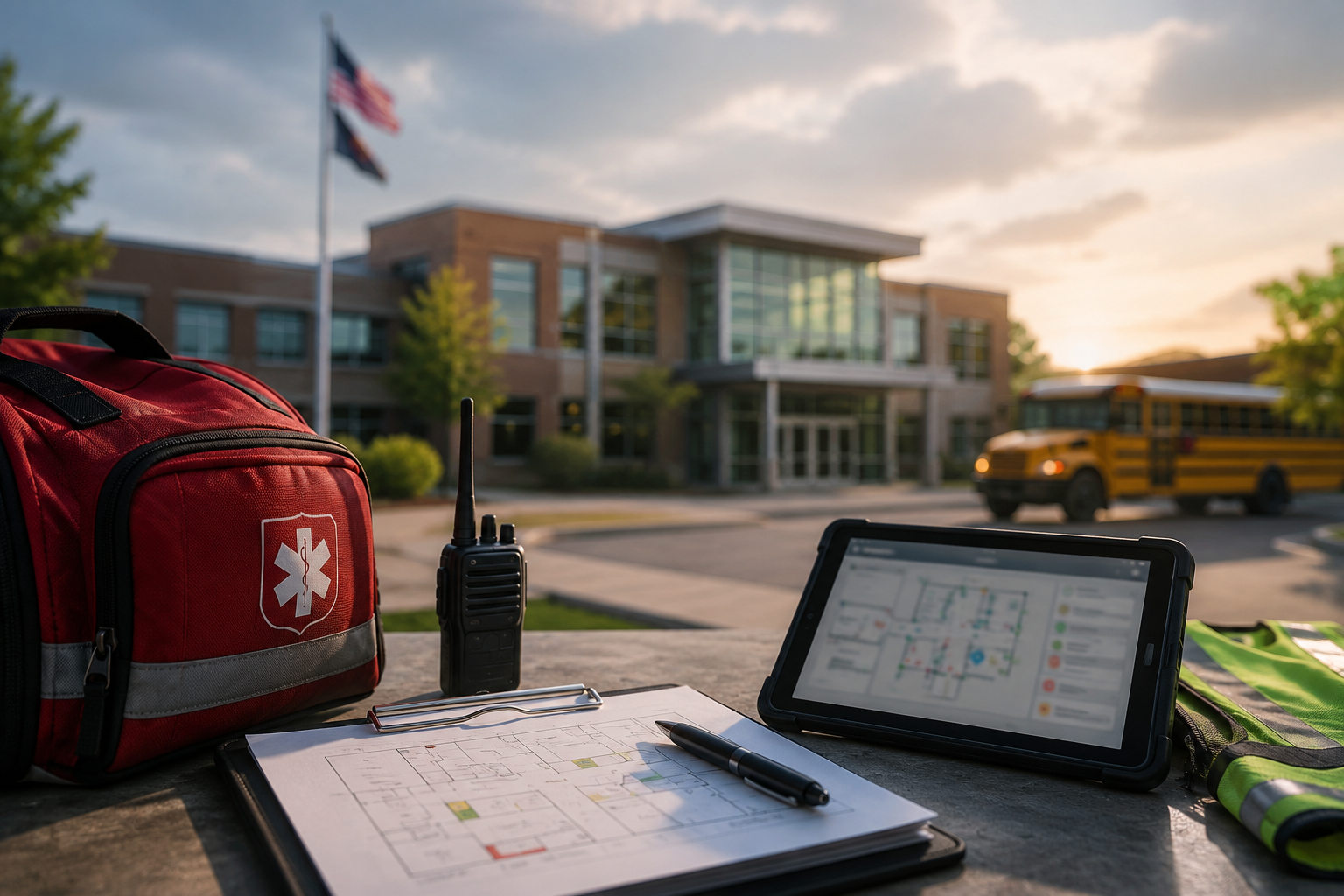
Most school districts have written emergency response plans. The harder problem is whether those plans can actually be executed when an incident occurs. Operational readiness requires that staff know their roles, that communication channels work under pressure, that exercises are completed and documented consistently, and that identified gaps are corrected before the next event. According to the National Center for Education Statistics, more than 90% of public schools had written plans for several emergency scenarios in 2021–22 (NCES, 2024). Plan ownership is not the same as operational readiness — the sections below explain what separates a compliant document from a district that is genuinely prepared to act.
Key Takeaways
- Most school districts have written emergency plans, but plan ownership isn't the same as operational readiness. The real challenge is executing those plans consistently across every school, department, and outside agency.
- High drill-completion rates don't confirm that district-level coordination, executive decision-making, communications, or continuity of operations will hold up in a real incident.
- Effective emergency response is a district-wide leadership responsibility spanning school administrators, IT, transportation, facilities, student services, communications, and external agencies, not a job limited to security or facilities staff.
- Cyberattacks, severe weather, utility failures, and other operational emergencies demand the same disciplined cycle of planning, exercising, documenting, and correcting gaps that physical security scenarios require.
- Continuous readiness is a manageable operating practice built on regular exercises, clear roles, documented observations, and closed corrective actions, not an occasional large-scale project or a compliance checkbox.
What Does Operational Readiness Actually Mean for a School District?
Operational readiness means a school district can execute its emergency response plans, not just produce them. It requires that staff across every school and department know their roles, that communication channels function under pressure, that exercises are conducted and documented consistently, and that identified gaps are corrected before the next incident occurs.
Most districts have done the foundational work. According to NCES, in 2021–22 more than 90% of public schools had written plans covering multiple emergency scenarios, and approximately 96% had drilled students on lockdown procedures (NCES, 2024). That level of plan ownership is meaningful, but it answers only one question: does a document exist?
Operational readiness asks a harder set of questions. Can the principal at every campus locate the current version of their emergency operations plan and explain their role in it? Do the district's phone trees, mass notification systems, and two-way radios actually function when normal infrastructure is stressed? If the superintendent needs to make a critical decision during a crisis, is there a defined process for who provides information, who authorizes action, and who communicates with parents, media, and response agencies?
For a multi-school district, this creates a coordination challenge that a single plan cannot resolve on its own. A district serving fifteen schools across different neighborhoods may be managing fifteen different facility profiles, student populations with varying medical and behavioral needs, and relationships with different local fire, police, and EMS contacts. Conducting drills is not the same as testing coordination: an annual fire evacuation confirms students can exit a building in an orderly way, but it does not test whether the transportation director knows when to activate the reunification protocol, whether IT understands its role in a cybersecurity incident, or whether the crisis communications team can reach every stakeholder within a defined window.
Why Do Emergency Plans Fail When Districts Need Them Most?
Emergency plans most often fail school districts at the moment of execution, not at the moment of creation. When staff are uncertain about their roles, communication channels break down under pressure, plans have not been tested across schools and departments, and corrective actions from past exercises go unresolved, even a well-documented plan cannot reliably guide a coordinated response.
Plan failure typically follows predictable patterns. A staff member who changed roles six months ago still holds a response responsibility they no longer understand. A communication tree that works between a principal and the district office breaks when the primary contact is unavailable and no one has tested the backup. An IT team that has never participated in an emergency exercise does not know at what point a cyberattack crosses from an IT issue into a district-wide operational emergency, even though 82% of K-12 schools experienced a cyber incident between July 2023 and December 2024, according to a Center for Internet Security survey cited by K-12 Dive (2026).
Role ambiguity is one of the most consistent contributors to response failures. The U.S. Department of Education, FEMA, DHS, HHS, and DOJ noted in their 2013 joint guide for developing school emergency operations plans that the common thread in successful operations is that participating organizations understood and accepted their roles before an incident occurred. Inter-agency coordination adds another layer of risk: the GAO found in 2016 that only about half of K-12 districts conducted annual exercises jointly with police and fire officials, meaning many districts plan alongside first responders they have rarely practiced with under realistic conditions.
Most plan failures are not dramatic or sudden. They accumulate quietly: a corrective action from last year's exercise that was never assigned to anyone, a communication channel updated in one school's plan but not across the district, a scenario that has never been tested because finding the time seemed difficult. The GAO (2016) reported that approximately 59% of districts cited difficulty balancing emergency planning with higher-priority demands such as classroom instruction time. That pressure is legitimate, but it means readiness gaps tend to compound rather than resolve on their own, and they are rarely visible until the moment they matter most.
Which Roles and Departments Are Responsible for District-Wide Emergency Response?
Effective district-wide emergency response is a shared responsibility across multiple functions, not a single department. District leadership, school principals, communications staff, IT, transportation, facilities, student services, and legal teams each carry defined roles. External agencies, including local police, fire departments, emergency management offices, and public health authorities, are also integral to a coordinated response.
When an emergency occurs, the instinct is often to look to security or facilities staff as the primary owners of response. That assumption creates a gap. A school closure following a cyberattack requires IT and district leadership. A severe weather event affecting student transportation requires principals, transportation directors, and parents to coordinate simultaneously. A medical emergency on campus may involve the school nurse, local EMS, communications staff managing parent inquiries, and the superintendent's office within the same hour.
That coordination challenge scales with district size. Consider the range of functions a district-level emergency may require to activate at once: district administration setting priorities and authorizing decisions, principals executing site-level protocols, communications managing information to parents and media, IT managing access and system integrity, transportation coordinating buses or staging areas, facilities managing physical access, student services supporting students with disabilities or medical needs, and legal counsel advising on liability and disclosure. Only about half of K-12 districts surveyed conducted annual joint exercises with police and fire officials, according to the GAO (2016), which means many districts are planning alongside first responders they have rarely practiced with under realistic conditions.
Building genuine coordination means more than listing contacts in an emergency operations plan. It means every person named in a response role understands the escalation chain, knows who makes which decisions, and has practiced those responsibilities in a controlled exercise environment. It also means that when personnel change, which happens regularly in school districts, the role knowledge transfers with them, not just the title.
How Do Exercises, Drills, and After-Action Reviews Strengthen District Readiness?
Exercises, drills, and after-action reviews strengthen district readiness by testing whether plans, roles, and communication procedures actually function under realistic conditions. Drills confirm individual-school responses to specific scenarios. Tabletop exercises and functional simulations test district-level coordination, decision-making, and inter-agency communication. After-action reviews convert observations into documented, assigned corrective actions that close identified gaps before a real incident occurs.
Most districts conduct drills: approximately 96% of public schools drilled students on lockdown procedures and 93% on both shelter-in-place and evacuation scenarios in 2021–22 (NCES, 2024). That level of participation is meaningful, but drills are scenario-specific and school-level by design. They confirm that staff can move students to a safe location or secure a building. They do not confirm that the district office receives accurate situation updates, that communications has current messaging templates, that transportation has a protocol for a mid-route incident, or that IT and facilities are integrated into the response workflow.
That distinction matters because most real emergencies create coordination demands above the school level. A ransomware attack, which affected 82% of K-12 schools between July 2023 and December 2024 according to the Center for Internet Security, is not a building-level event at all. It requires coordinated action from IT, district leadership, legal counsel, and communications, often under significant time pressure and incomplete information. A tabletop exercise brings key decision-makers together to walk through a realistic scenario in a structured discussion format, exposing who calls whom, who has authority to make which decisions, and whether the plan holds together when conditions change mid-scenario.
Joint exercises surface assumptions that neither party knew it had made. A school may assume the local fire department will use a specific entrance; the fire department may assume the school will have cleared that area before arrival. Neither assumption appears in either party's written plan, but a joint tabletop exercise finds it before a real incident does, and closing that gap matters, since the GAO found only about half of K-12 districts conducted annual joint exercises with police and fire officials in 2016.
After-action reviews are where the exercise cycle produces lasting improvement. An after-action review is a structured process, conducted shortly after an exercise or real incident, that captures what worked, what did not, and what specific actions are needed. Its value depends entirely on what happens next: observations that are discussed but not documented do not change anything, and documented observations that are not assigned to a responsible owner and tracked to completion do not either. Closing that loop means treating exercises as part of a continuous process, where each observation produces an assigned corrective action with an owner, a deadline, and a status visible to district leadership, so the next exercise builds on that record instead of repeating conversations that already happened.
What Are the Most Common Gaps Between a Written Plan and a District That Can Execute It?
Most school districts have written emergency plans, but gaps typically appear in four areas: staff who cannot recall their assigned roles under pressure, communication procedures that have not been tested across schools and external agencies, exercises that do not reflect the full range of scenarios the district faces, and corrective actions from past drills that were never formally closed.
Role clarity is one of the most reliable predictors of effective response. The joint interagency Guide for Developing High-Quality School Emergency Operations Plans notes that the common thread in successful operations is that participating organizations understood and accepted their roles, and that planning works best when performed by a team rather than assigned to a single coordinator (U.S. Department of Education et al., 2013). When staff turnover occurs or an incident unfolds in a way that doesn't match the drill scenario, role ambiguity quickly becomes an operational problem.
Communication procedures present a related challenge: a plan that lists who should be contacted but has never been run through an actual scenario leaves districts uncertain whether those contacts are current or whether messages will reach the right people in the right sequence. Scenario coverage is another gap plans alone cannot resolve. Between November 2022 and October 2024, K12 Security Information Exchange reported 85 ransomware incidents targeting K-12 public schools, and the average cost of downtime from a ransomware attack totals $548,185 per day for educational institutions, according to Comparitech data cited by K-12 Dive (2025). Cyber incidents are a mainstream operational scenario requiring coordination across IT, communications, and district leadership, not just a technical response.
Perhaps the most underappreciated gap is corrective-action follow-through. The GAO estimated that only about half of surveyed K-12 districts conducted annual joint exercises with police and fire officials, and roughly the same proportion had procedures for continuing operations or recovering after an incident (GAO, 2016), a pattern that suggests exercises are often episodic events rather than part of a continuous improvement cycle. A plan stored in a binder or a shared folder cannot prompt a staff member to review their responsibilities, cannot flag when an action item has been outstanding for six months, and cannot show a superintendent or school board that preparedness activities are happening consistently across every school.
How Can Districts Demonstrate Continuous Readiness to Boards, Regulators, and the Community?
School districts demonstrate continuous readiness by maintaining documented evidence of completed exercises, resolved corrective actions, updated plans, and coordinated staff training, not by presenting a plan binder alone. Boards, regulators, and community stakeholders increasingly expect districts to show that preparedness is an ongoing operational practice, with measurable outcomes and clear accountability across every school site.
When a board member asks whether the district is prepared for a major incident, the honest answer requires evidence: a record of completed exercises, documented observations, corrective actions that were assigned and closed, and plans that were updated in response to what was learned. FEMA's guidance framework and the joint interagency School Emergency Operations Plan guide all reinforce that effective emergency management is a continuous process, not a one-time planning event.
Community trust works the same way. Families are not positioned to evaluate an emergency operations plan directly, but they are affected by how a district communicates before, during, and after an incident. Districts that can speak clearly about what they have practiced and how they coordinate with local first responders build credibility that a static document cannot provide.
The accountability gap often appears not in the existence of plans but in the absence of a consistent record. When exercises are documented informally, corrective actions are tracked in separate spreadsheets, and updates to individual school plans aren't centrally visible, it becomes difficult for district leadership to answer basic readiness questions with confidence. Demonstrating continuous readiness means building a system of record that captures planning, exercises, incidents, and improvement activities consistently across every school site, and makes that record accessible to the people who need to report on it.
Key Readiness Statistics at a Glance
- NCES (2024): More than 90% of public schools had written plans for multiple emergency scenarios in 2021–22; about 96% had drilled students on lockdown procedures, and 93% on both shelter-in-place and evacuation.
- U.S. Dept. of Education, FEMA, DHS, HHS & DOJ (2013): The common thread in successful emergency operations is that participating organizations understood and accepted their roles before an incident occurred.
- Center for Internet Security, cited by K-12 Dive (2026): 82% of K-12 schools experienced a cyber incident between July 2023 and December 2024.
- U.S. GAO (2016): Only about half of K-12 districts conducted annual joint exercises with police and fire officials; roughly 59% cited difficulty balancing emergency planning with higher-priority demands like instruction time.
- K12 Security Information Exchange: 85 ransomware incidents targeted K-12 public schools between November 2022 and October 2024.
- Comparitech, cited by K-12 Dive (2025): The average cost of ransomware-related downtime for educational institutions is $548,185 per day.
The Bottom Line for District Leaders
- Treat plan ownership and operational readiness as two different questions, and track evidence for both.
- Assign every response role to a named person, and re-confirm it whenever staff change.
- Run tabletop exercises that test district-level coordination and inter-agency hand-offs, not just single-school drills.
- Close the loop on every after-action finding: assign an owner, a deadline, and a status visible to district leadership.
- Keep a consolidated, current record you can hand to a board member, regulator, or insurer without reconstructing it first.
This is the discipline Opsbook is built to support: connecting a district's plans, exercises, evaluations, and after-action reports into one continuously improving system, so preparedness gaps get identified, fixed, and verified over time instead of resetting after every drill.
See how Opsbook helps districts turn plans into practiced, evidenced readiness →
.png)